Chief Human Resources Officer (CHRO) Program by Wharton [In Depth Review][2026]

In an era where talent is the currency of competitive advantage and culture is a board-level priority, the Chief Human Resources Officer (CHRO) has emerged as one of the most critical roles in the C-suite. No longer confined to administrative oversight, today’s CHROs are strategic architects of organizational transformation, executive partners in business growth, and stewards of inclusion and employee experience. To succeed in this elevated role, HR leaders must master a new blend of competencies—spanning data analytics, strategic leadership, and cross-functional influence.
Among the many programs designed to prepare leaders for this expanded mandate, the Chief Human Resources Officer Program by Wharton Executive Education stands out for its depth, academic rigor, and executive focus. Backed by the intellectual capital of one of the world’s most prestigious business schools, this program has become a premier choice for CHROs and senior HR professionals seeking to lead with confidence and global credibility.
At DigitalDefynd, our mission is to help leaders choose learning experiences that drive real strategic growth. After evaluating hundreds of executive education offerings in human capital, leadership, and enterprise strategy, we believe Wharton’s CHRO Program is uniquely positioned to equip senior HR leaders for the future of work and the future of leadership.
1. About the Program
| Program at a Glance | |
| Program Name | Chief Human Resources Officer (CHRO) Program |
| Duration | 9-12 months |
| Mode | Online + On Campus |
| Program Fee | US$19,000 |
| Application Fee | US$300 |
| Faculty | Matthew Bidwell, PHD; Academic Director for the CHRO Program, Wharton Executive Education; Professor of Management, The Wharton School |
| John Paul Macduffie, PHD; Professor of Management, The Wharton School | |
| Andrew Carton, PHD; Associate Professor of Management, The Wharton School | |
| Nicolaj Siggelkow, PHD; Professor of Management, Co-Director of the Mack Institute for Innovation Management, The Wharton School | |
| Certificate Program | Yes |
| DigitalDefynd Rating | 9 out of 10 |
| Signup Info | Sign up Here |
The Chief Human Resources Officer Program by Wharton Executive Education is a transformative executive learning experience designed for HR leaders who are ready to operate at the highest levels of strategic influence. Built around the evolving responsibilities of the modern CHRO, the program goes beyond traditional HR training to deliver insights and capabilities needed to lead organizational change, shape workplace culture, and align human capital strategy with business goals.
Structured over a 9 to 12 month period, the program combines self-paced online modules, live faculty-led virtual sessions, and an optional in-person networking and recognition event at Wharton’s campus in Philadelphia. Participants benefit from a modular approach that blends academic depth with practical application, enabling them to implement key learnings in real time within their organizations.
Key themes include strategic HR leadership, data-driven decision-making, diversity and inclusion, succession planning, and performance management. The curriculum is led by Wharton’s world-renowned faculty, supported by global experts and industry practitioners, ensuring that participants gain both theoretical frameworks and actionable insights.
Participants also complete a capstone project, which allows them to tackle a real organizational challenge using tools and strategies developed during the program. This hands-on approach ensures that learning is not only retained but applied in a way that drives tangible business outcomes.
The program’s flexible, blended format is designed for senior professionals balancing complex roles, making it ideal for executives seeking growth without pausing their careers.
2. Who Should Enroll
The Chief Human Resources Officer Program is ideal for experienced professionals who are leading, or preparing to lead, high-impact human capital strategy and enterprise-wide transformation. It is designed specifically for those who want to elevate their strategic role, expand cross-functional influence, and align people operations with broader business objectives in an increasingly complex and dynamic business environment.
This program is best suited for:
- Chief Human Resources Officers and Chief People Officers aiming to refine their leadership style, enhance boardroom presence, and stay ahead of global trends in talent strategy, digital HR transformation, and cultural innovation.
- Senior HR Executives and Heads of Talent, Engagement, People Strategy, or Organizational Development who are ready to step into more enterprise-facing roles, take ownership of business outcomes, and drive leadership development across the organization.
- HR Business Partners, VPs, and Directors responsible for large teams, international markets, or key transformation initiatives who seek to sharpen their strategic acumen and prepare for the responsibilities of the C-suite.
- Functional leaders in performance management, DEI, workforce analytics, and succession planning looking to transition into broader strategic roles that influence enterprise growth and long-term business sustainability.
- Business leaders and general managers with significant people leadership responsibilities who wish to better understand the evolving CHRO function and integrate human capital strategy with business planning.
Participants typically have 10 or more years of professional experience in HR or a related leadership function, often with experience navigating organizational change, scaling teams, or supporting cross-border operations. Many come from industries undergoing rapid transformation—such as technology, healthcare, finance, and manufacturing—and are looking for the tools and network to lead in volatile, high-growth, or restructuring environments.
While a background in HR is central, the program also welcomes professionals in adjacent roles—such as operations, legal, or enterprise strategy—who want to step into a CHRO capacity or collaborate more effectively with the people leadership function.
Whether you’re already in the C-suite or actively preparing for the next step, this program offers a powerful platform to develop the executive mindset, strategic foresight, and cross-functional leadership needed to thrive in today’s people-first, transformation-driven business world.
3. Curriculum and Learning Outcomes

The Chief Human Resources Officer Program offers a comprehensive, future-focused curriculum designed to prepare HR leaders for the strategic and transformational demands of the modern enterprise. It moves beyond traditional HR training to equip participants with the tools, insights, and frameworks required to drive impact at the C-suite level—combining academic rigor with actionable learning that can be immediately applied within the workplace.
Structured over 9 to 12 months, the curriculum is delivered through a combination of self-paced online modules, live virtual sessions, and interactive case-based discussions led by Wharton faculty and global practitioners. The course content is designed around the full spectrum of CHRO responsibilities, with an emphasis on strategic alignment, leadership development, culture-building, and data-driven decision-making.
Core modules include:
- Elevating the CHRO Role: Understand the shift from tactical execution to strategic leadership and how CHROs shape business priorities.
- Human Capital and Talent Strategy: Explore techniques for workforce planning, succession management, and building robust talent pipelines aligned with business needs.
- Leading Culture and Organizational Change: Learn to design and drive cultural transformation that supports agility, inclusion, and high performance.
- Performance Management and Employee Experience: Redefine performance systems and understand how to align employee aspirations with organizational goals.
- Diversity, Equity, and Inclusion (DEI): Examine evolving frameworks and strategies for embedding equity and belonging into the core of the business.
- People Analytics and New Technologies: Gain hands-on exposure to tools and methodologies that support evidence-based HR decision-making.
- Leadership Styles and Executive Influence: Identify your leadership profile and learn how to influence stakeholders across the C-suite and boardroom.
Each module integrates academic theory with real-world case studies, fireside chats with CHROs and industry leaders, and opportunities for group reflection. Throughout the program, participants engage in activities that encourage cross-functional thinking and sharpen strategic insight.
In addition to the core curriculum, participants choose three specialized electives that allow deeper exploration of topics such as executive presence, corporate governance, HR analytics, and the future of work. These electives ensure that each learner can tailor the experience to their current role and future ambitions.
To reinforce application of learning, participants also complete a capstone project, which challenges them to address a real business issue within their organization. This hands-on assignment serves as a strategic blueprint for driving meaningful transformation in their own workplace—whether through redesigning performance systems, advancing DEI goals, or leading a digital HR initiative.
By the end of the program, participants will have developed the strategic mindset, leadership presence, and operational expertise required to thrive as CHROs in today’s fast-changing and people-driven business landscape.
4. Capstone Project
A defining feature of the Chief Human Resources Officer Program by Wharton Executive Education is the capstone project, a culminating assignment that empowers participants to translate learning into real-world leadership impact. Rather than being purely theoretical, the capstone serves as a strategic action plan, giving participants the opportunity to apply insights from across the program to a pressing organizational challenge or transformation initiative.
Throughout the duration of the program, participants explore a wide range of topics—from human capital strategy and culture building to analytics and executive influence. The capstone acts as a structured outlet for integrating these insights into a comprehensive, high-level HR solution. Whether the focus is succession planning, employee engagement, DEI transformation, or redefining performance systems, the capstone provides a chance to develop a personalized strategic roadmap with tangible outcomes.
Participants are encouraged to select a challenge that is both timely and aligned with their current responsibilities or future leadership aspirations. As they progress through the modules, each section of the curriculum feeds into the development of this project—ensuring it reflects the program’s full intellectual scope and strategic frameworks.
Key components of the capstone may include:
- Defining a strategic HR challenge or transformation goal
- Analyzing current organizational dynamics, workforce metrics, or leadership gaps
- Outlining a phased action plan tied to business objectives
- Applying people analytics to support decision-making
- Designing cultural, leadership, or talent interventions for scalable impact
- Building stakeholder alignment and an executive communication plan
Throughout the project, participants receive support from their dedicated success coach, who provides guidance and feedback to ensure the final deliverable is both ambitious and practical. By the end of the program, participants walk away with a fully developed strategic initiative they can present to their C-suite, implement within their team, or use to accelerate broader organizational change.
Beyond showcasing mastery of the program content, the capstone project reinforces the mindset shift central to the CHRO role—moving from function-specific oversight to enterprise-wide leadership. It is not only a learning exercise, but a launchpad for executive action.
| Program at a Glance | |
| Program Name | Chief Human Resources Officer (CHRO) Program |
| Duration | 9-12 months |
| Mode | Online + On Campus |
| Program Fee | US$19,000 |
| Application Fee | US$300 |
| Certificate Program | Yes |
| DigitalDefynd Rating | 9 out of 10 |
| Signup Info | Sign up Here |
5. Key Features and Format

The Chief Human Resources Officer Program by Wharton Executive Education is thoughtfully structured to meet the unique needs of senior executives balancing complex leadership responsibilities. It offers a blended learning experience that combines academic rigor, real-time interaction, and strategic flexibility—making it ideal for high-level professionals who want to learn without stepping away from their roles.
The program spans 9 to 12 months, with a curriculum delivered primarily online through a mix of self-paced core modules, live virtual sessions, and interactive case discussions. This format allows participants to absorb content at their own pace while benefiting from scheduled engagement with faculty and peers. The course content is made available through an intuitive digital platform, enabling participants to access videos, readings, case studies, and assignments from anywhere in the world.
One of the program’s signature components is the optional two-day in-person networking and recognition event held at Wharton’s Philadelphia campus. This event offers an opportunity for participants to meet faculty, peers, and industry leaders face-to-face, building lasting relationships in an immersive learning environment. While optional, it significantly enriches the experience for those seeking deeper engagement and global executive exposure.
Additional key features include:
- Dedicated Success Coach: Each participant is paired with a success coach who offers personalized guidance throughout the program. Coaches help align course content with leadership goals, advise on the capstone project, and ensure participants stay on track.
- Global Peer Learning: Participants join a diverse, senior-level cohort of HR and business leaders from across industries and geographies. Peer interactions—through live discussions, team exercises, and networking events—are central to the program’s collaborative approach.
- Expert-Led Live Sessions: At key intervals, participants engage in live sessions with Wharton faculty and industry experts. These sessions cover advanced topics such as organizational change, leadership communication, and data-driven HR strategy, and offer real-time opportunities for Q&A and executive dialogue.
- Elective Customization: Learners can personalize their journey by selecting three elective modules that align with their specific interests and career aspirations. Elective topics range from executive presence and influence to the future of work and corporate governance.
- Real-World Application: The modular design ensures that participants can immediately apply what they learn to their current roles. With a strong focus on strategy and execution, the course encourages reflection, experimentation, and action within live organizational contexts.
This hybrid model of learning—supported by top-tier instruction, peer exchange, and hands-on application—makes the Wharton CHRO Program uniquely impactful. It allows senior leaders to sharpen their strategic edge, expand their executive toolkit, and lead with greater clarity and confidence—without interrupting their professional momentum.
6. Faculty and Thought Leadership

A cornerstone of the CHRO program by Wharton is its world-class faculty—leading academics and industry experts who bring a powerful blend of research-driven insight and real-world experience. Participants learn directly from professors who are globally recognized for their contributions to management, organizational behavior, strategy, and leadership development, ensuring that every session is grounded in both intellectual depth and executive relevance.
At the center of the program is Matthew Bidwell, PhD, Academic Director and Professor of Management at The Wharton School. Widely respected for his work on employment dynamics, staffing strategies, and career mobility, Professor Bidwell brings unique expertise in how organizations manage talent in complex environments. His research has been published in leading academic journals and cited by major media outlets, and he is known for translating cutting-edge theory into frameworks that leaders can apply within their organizations.
Supporting faculty include other prominent Wharton professors such as:
- John Paul MacDuffie, PhD: An expert in innovation and organizational learning, known for his work on strategic transformation and systems thinking.
- Andrew Carton, PhD: A specialist in leadership and communication, focusing on how executives shape meaning and inspire alignment across diverse teams.
- Nicolaj Siggelkow, PhD: Co-Director of the Mack Institute for Innovation Management, whose teaching explores how organizations adapt to disruption and digital change.
These faculty members bring decades of teaching and consulting experience with Fortune 500 companies, global institutions, and executive boards. Their sessions combine lectures, case studies, and interactive discussion, encouraging participants to challenge assumptions and refine their leadership perspective.
In addition to the core teaching team, the program features guest practitioners, industry speakers, and CHROs from top organizations who share practical insights from their careers. These fireside chats and applied sessions offer a behind-the-scenes look at how real-world HR leaders navigate issues like scaling culture, leading transformation, managing through crisis, and driving change from the C-suite.
This dual lens—combining academic theory with executive practice—ensures that participants receive a well-rounded and actionable learning experience. The faculty’s ability to connect strategic thinking with operational reality makes the program especially valuable for leaders who want to strengthen both their intellectual toolkit and their capacity to lead complex, people-driven transformation.
Whether exploring high-level frameworks or diving into current case challenges, the faculty’s guidance helps participants move from knowledge to execution—preparing them to lead with greater insight, influence, and confidence.
7. Elective Options
A standout feature of the Chief Human Resources Officer Program from Wharton is its flexible elective structure, which allows participants to tailor their learning journey based on their individual leadership goals and professional interests. While the core curriculum provides a comprehensive foundation in strategic HR and organizational leadership, the elective options offer a chance to explore specific themes in greater depth—enhancing both personalization and relevance.
Each participant selects three electives, each lasting approximately six weeks, from a curated list of topics aligned with the evolving demands of HR and executive leadership. These electives are fully integrated into the overall learning journey and are delivered through a combination of self-paced content, live faculty engagement, and practical assignments.
Elective topics include:
a. Executive Presence and Influence
This elective focuses on building the communication, confidence, and leadership visibility required to operate effectively at the C-suite level. Participants learn how to enhance their executive voice, lead through ambiguity, and command credibility in high-stakes settings.
b. Corporate Governance
Designed for leaders who interact with boards or sit on governance committees, this elective explores how to navigate board dynamics, regulatory expectations, and fiduciary responsibilities. It also addresses the CHRO’s role in shaping governance-related decisions on succession and compensation.
c. Mastering Talent Management
This track dives deeper into strategies for attracting, engaging, and retaining top talent. It covers best practices in workforce planning, development pathways, and reward systems that align individual performance with organizational outcomes.
d. Future of Work
This forward-looking elective examines trends shaping the workplace, from hybrid models and digital collaboration to workforce automation and generational diversity. It prepares HR leaders to anticipate change and build future-ready talent strategies.
e. HR Management and Analytics
Ideal for those interested in data-driven HR leadership, this elective teaches how to use analytics to measure, forecast, and optimize workforce performance. Topics include predictive modeling, KPI design, and real-time decision dashboards.
f. M&A and Corporate Development Strategies
This elective is suited for leaders involved in organizational growth, integrations, or restructuring. Participants explore the HR implications of mergers and acquisitions, including cultural integration, talent alignment, and change leadership.
Each elective is taught by expert faculty with deep knowledge in the subject matter and is accompanied by industry cases, reflection exercises, and tools that support immediate application. Electives are offered on a rotating schedule to maximize flexibility and accommodate different time zones and work commitments.
By selecting electives that align with their functional responsibilities or career ambitions, participants ensure that their CHRO Program experience is not only comprehensive, but also uniquely aligned to their personal path as a strategic leader. These electives add dimension to the program, allowing every participant to customize their development and deepen expertise in the areas that matter most to them and their organizations.
8. Certification and Alumni Benefits
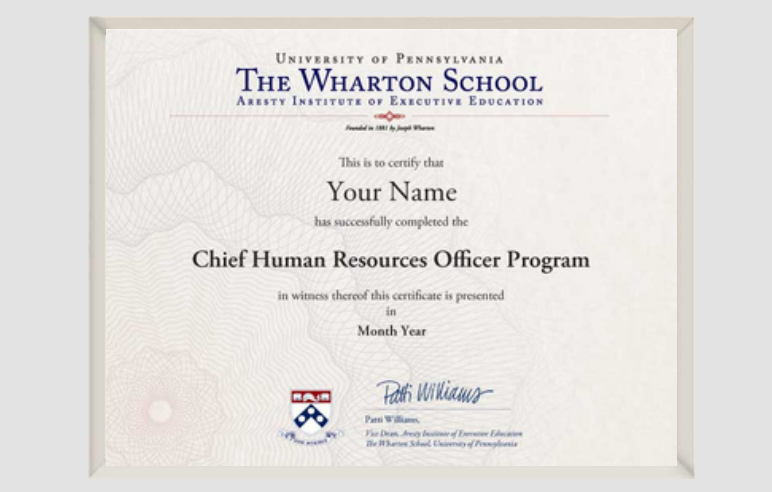
Upon successful completion of the Chief Human Resources Officer Program, participants are awarded a Wharton Executive Education digital certificate—a prestigious recognition that validates their commitment to leadership development at the highest level. This certificate serves not only as a credential of achievement, but also as a marker of readiness to take on expanded strategic and enterprise responsibilities within their organization or across the C-suite.
The digital certificate is issued in the participant’s name and can be displayed on professional platforms such as LinkedIn or included in executive CVs and board dossiers. It reflects the completion of all core modules, selected electives, and the capstone project, signaling mastery of advanced HR leadership competencies.
While the certificate does not confer a formal degree or alumni status from the University of Pennsylvania, it does open the door to a pathway toward Wharton alumni benefits—a rare opportunity within the executive education space. Participants who complete the CHRO Program and later enroll in additional open-enrollment courses from Wharton Executive Education may, subject to specific criteria and tuition thresholds, qualify for alumni status.
Pathway to Wharton Alumni Status Includes:
- Eligibility to apply for alumni club membership across 77+ regional and global networks
- Invitations to attend Wharton Global Forums and other alumni events
- Access to select career and networking platforms, fostering long-term professional growth
- The opportunity to obtain a Wharton email address, reinforcing affiliation with one of the world’s top business schools
Additionally, graduates gain long-term access to the Wharton Executive Education learning ecosystem—including program updates, industry insights, and ongoing opportunities to engage with faculty and thought leadership content.
This combination of certification and extended benefits enhances the overall value of the CHRO Program. It provides not only recognition for what participants have accomplished, but also continued access to a global professional community dedicated to leadership, innovation, and impact. For senior HR executives looking to signal their readiness for enterprise leadership and stay connected to a top-tier learning network, these benefits represent a significant and enduring return on investment.
| Program at a Glance | |
| Program Name | Chief Human Resources Officer (CHRO) Program |
| Duration | 9-12 months |
| Mode | Online + On Campus |
| Program Fee | US$19,000 |
| Application Fee | US$300 |
| Certificate Program | Yes |
| DigitalDefynd Rating | 9 out of 10 |
| Signup Info | Sign up Here |
9. Participant Profile and Admissions
The Chief Human Resources Officer Program by Wharton Executive Education is designed for seasoned professionals who are operating in, or preparing to step into, high-level leadership roles within human resources or people strategy. Participants come from a diverse array of industries and geographies, but share a common goal: to lead transformative change, influence executive decision-making, and drive business performance through strategic human capital leadership.
Ideal Participant Profile:
- Chief Human Resources Officers and Chief People Officers seeking to enhance strategic capability, build global HR perspectives, and lead enterprise-wide transformation initiatives.
- Senior HR leaders across functions such as talent management, organizational development, employee experience, DEI, learning and development, and workforce planning who are preparing for C-suite responsibilities.
- HR Directors, VPs, and Business Partners managing large teams or regions and looking to increase cross-functional influence, refine leadership presence, and position themselves for broader organizational leadership.
- Functional leaders with responsibilities in compliance, performance management, analytics, or transformation who are ready to expand their strategic horizons and take on higher-level roles.
- Executives outside HR—such as COOs or general managers—who oversee HR teams or are deeply involved in people-centric initiatives and want to gain structured expertise in leading talent and culture.
Participants typically bring 10+ years of professional experience, with many already holding senior leadership positions within global or complex organizations. While prior HR experience is recommended, the program also welcomes those from related disciplines with strong people leadership responsibilities.
Admissions Process:
The admissions process is straightforward but selective, designed to ensure a strong fit between participants’ backgrounds and the strategic focus of the program. Applications are reviewed on a rolling basis, so early submission is encouraged.
Steps to Apply:
1. Online Application Submission
Candidates complete a short application outlining their professional background, leadership experience, and goals for joining the program.
2. Application Fee
A non-refundable fee of USD $100–$200 applies depending on the admission round. This fee must be submitted with the application.
3. Evaluation and Offer
The admissions team reviews all submissions to confirm alignment with the program’s senior leadership profile. Selected applicants receive an offer and instructions for final enrollment.
4. Enrollment and Onboarding
Once admitted, participants receive access to pre-program materials and guidance on preparing for the learning journey.
Program Fee and Inclusions:
- Tuition Fee: USD $22,000
- Optional On-Campus Event Fee: USD $250
- Inclusions: Teaching fees, digital coursework, access to the learning platform, faculty interaction, success coach support, and the capstone project.
Exclusions: Travel, lodging, and visa-related expenses for the in-person component, along with other incidental costs.
Given the global demand for strategic HR leadership, the Wharton CHRO Program attracts a high-caliber executive cohort. It offers not just learning, but entry into a trusted peer network and a world-class academic environment—making it an exceptional opportunity for ambitious senior leaders ready to take their influence to the next level.
10. What Past Participants Say
One of the strongest validations of the Chief Human Resources Officer Program by Wharton Executive Education comes from the feedback of past participants—many of whom credit the experience with transforming their approach to leadership, broadening their strategic perspective, and accelerating their career progression.
Across testimonials, a few consistent themes emerge: the value of Wharton’s faculty expertise, the real-world relevance of the curriculum, the quality of the peer cohort, and the immediate applicability of the content. Participants highlight how the program helped them think beyond HR operations, giving them the tools and confidence to lead enterprise-wide change and engage more effectively with the CEO, board, and other C-suite leaders.
Key Takeaways from Participant Feedback:
1. Strategic Clarity and Broadened Perspective
Many participants report a shift in how they view their role within the organization. Instead of operating as functional experts, they now see themselves as business leaders who shape culture, influence performance, and align HR strategy with long-term corporate goals.
2. Confidence to Lead at the Executive Level
Graduates often mention a noticeable improvement in their executive presence and ability to engage in strategic conversations. The program equips them with both the language and frameworks needed to operate confidently alongside other members of the C-suite.
3. Real-Time Application of Learning
Participants praise the curriculum for its practicality. Through the capstone project and weekly reflections, they are able to apply insights directly to their teams and organizations—whether it’s redesigning a talent strategy, initiating a culture change initiative, or leveraging analytics for better workforce planning.
4. Global Peer Learning and Networking
The cohort experience is frequently cited as one of the program’s most valuable aspects. Learning alongside senior HR leaders from around the world offers exposure to diverse approaches, industry challenges, and cultural nuances, enriching the overall learning journey.
Examples of Participant Reflections:
“The program changed the way I show up as a leader. I now bring a more strategic, data-informed, and enterprise-focused mindset to every leadership conversation.”
“The modules are incredibly relevant and immediately actionable. I was able to design a new performance management approach that’s now being piloted across our business units.”
“What stood out most was the caliber of the peer group. I learned just as much from other participants as I did from the content—and those connections are still growing months after the program ended.”
“Wharton’s faculty brought a level of depth and insight that made each session thought-provoking and practical. The real-world case studies and leadership frameworks were top-tier.”
These testimonials demonstrate that the program offers much more than academic content—it fosters growth, reflection, and a strategic shift in how HR leaders define and deliver value. For professionals ready to step into more influential, enterprise-focused roles, the CHRO Program offers the perspective and preparation needed to succeed.
11. Pros and Cons
Like any executive education program, the Chief Human Resources Officer Program by Wharton Executive Education comes with both strengths and considerations. Based on participant feedback, curriculum analysis, and structural design, here is a balanced overview of what prospective learners can expect.
Pros
1. World-Class Academic Reputation
Wharton is consistently ranked among the top business schools globally, and its executive education offerings carry strong recognition in the corporate and HR leadership space. Completing a program from Wharton adds significant credibility to a leader’s professional profile.
2. Comprehensive and Strategic Curriculum
Unlike shorter or function-specific courses, the CHRO Program offers a deep dive into strategic HR leadership. It covers performance systems, talent pipelines, culture transformation, DEI, and analytics, preparing participants to lead in complex, high-growth environments.
3. Blended and Flexible Learning Format
With its mix of self-paced modules, live sessions, and an optional in-person networking event, the program caters to busy senior executives. It enables learning alongside work responsibilities without compromising academic depth.
4. Practical Application Through Capstone Project
The capstone is not a theoretical exercise—it allows participants to apply course insights to real business challenges. This results in a strategic deliverable with immediate relevance to the participant’s organization.
5. Personalized Coaching and Global Cohort
Each participant is assigned a success coach to guide their journey. The diverse peer group—from industries like tech, healthcare, manufacturing, and finance—adds tremendous value through shared experiences and collaborative learning.
6. Elective Customization
Participants can choose three electives based on their goals, enabling a more tailored and focused learning experience. This helps build niche expertise in areas like HR analytics, M&A, or executive presence.
Cons
1. Premium Price Point
At a total program cost of around USD $22,000 (plus $250 for the optional in-person event), the investment is significant. While the value is clear for many senior leaders, those without corporate sponsorship may find cost a barrier.
2. Time Commitment
Spanning 9 to 12 months, the program requires steady engagement and time management. For executives handling high-pressure roles or unpredictable schedules, this can present a challenge.
3. No Automatic Degree or Alumni Status
While the program offers a digital certificate and a pathway to Wharton alumni status, participants do not automatically receive full alumni benefits or academic credits from the University of Pennsylvania.
4. Travel Requirements for In-Person Event
Though optional, the in-person networking event adds great value. However, international participants may find travel logistics and visa requirements a limitation, especially if schedules are tight or borders are restricted.
5. Selective Elective Timing
Some electives may have limited availability or fixed schedules. Participants may need to plan ahead to ensure they enroll in electives most aligned with their interests.
Final Thoughts
For senior HR professionals ready to lead at an enterprise level, the Wharton CHRO Program offers unmatched strategic depth, real-time application, and leadership development. While the commitment—both financial and time-based—is considerable, the potential career impact, network access, and transformation of leadership capability make it a powerful investment for the right candidate.
12. Comparison with Other Programs
For senior HR leaders exploring executive education options, the Chief Human Resources Officer Program by Wharton Executive Education stands out in a competitive landscape. While several top institutions offer leadership and HR-focused programs, Wharton’s offering is uniquely designed to balance strategic depth, real-world application, and leadership development—positioning it as a comprehensive alternative to traditional HR certifications or shorter courses.
Here’s how the Wharton CHRO Program compares to some of the most recognized HR and leadership programs globally:
Wharton vs. Cornell ILR – Executive HR Leadership Programs
Cornell’s programs offer a strong academic foundation in labor relations, HR strategy, and employment law, often in shorter formats (2–3 months). These are ideal for mid-level managers or those looking for specialized certifications.
Wharton Advantage: A more immersive, senior-level experience that incorporates leadership transformation, cultural strategy, and capstone-driven outcomes.
Wharton vs. Harvard Business School – Leading People and Organizations
Harvard’s leadership programs are well-regarded and emphasize organizational behavior, change management, and decision-making, typically through shorter residential programs or online modules.
Wharton Advantage: A targeted focus on the evolving CHRO role, deeper treatment of HR-specific challenges, and more flexibility via the hybrid delivery model.
Wharton vs. INSEAD – HR Strategy in Transforming Organizations
INSEAD offers a global perspective and strong focus on digital transformation and diversity in HR leadership. The program is residential, fast-paced, and well-suited for globally mobile professionals.
Wharton Advantage: Greater flexibility for busy executives, a U.S.-centered peer network, and a capstone project that enables direct business application.
Wharton vs. London Business School – HR Strategy Programs
LBS delivers rigorous short courses on talent management, leadership development, and organizational effectiveness, often with a strong European context.
Wharton Advantage: A longer, modular program with a broader thematic scope, hands-on coaching, and multiple elective tracks for greater customization.
Wharton vs. Michigan Ross – Strategic HR Leadership Certificate
Michigan offers an excellent executive HR series with strong ties to research and analytics. However, the programs are often shorter and less tailored for C-suite HR leaders.
Wharton Advantage: More comprehensive coverage of CHRO-level responsibilities, strategic influence, and enterprise alignment over a sustained period of development.
Key Differentiators of Wharton’s CHRO Program:
- A 9–12 month learning journey with practical application and real-time impact
- A dedicated success coach for individualized guidance
- Choice of three elective modules for customized learning
- Optional in-person networking and recognition event for deep peer engagement
- Direct instruction from globally renowned Wharton faculty and real-world CHROs
- A capstone project that delivers organizational value and strategic clarity
While other programs may be shorter, more region-specific, or focused on technical HR areas, Wharton’s CHRO Program is built for strategic transformation at scale. It prepares leaders not just to manage HR functions—but to redefine them as engines of enterprise growth and innovation.
| Program at a Glance | |
| Program Name | Chief Human Resources Officer (CHRO) Program |
| Duration | 9-12 months |
| Mode | Online + On Campus |
| Program Fee | US$19,000 |
| Application Fee | US$300 |
| Certificate Program | Yes |
| DigitalDefynd Rating | 9 out of 10 |
| Signup Info | Sign up Here |
13. Final Verdict
In today’s people-first business landscape, the Chief Human Resources Officer plays a pivotal role in driving transformation, fostering culture, and aligning human capital strategy with enterprise goals. The Chief Human Resources Officer Program by Wharton Executive Education goes far beyond conventional HR training—it delivers a high-impact, executive-level experience for leaders who are ready to shape the future of work from the C-suite.
What makes this program truly stand out is its blended structure, strategic focus, and real-world application. With a curriculum designed and taught by Wharton’s renowned faculty, participants gain access to cutting-edge thinking on leadership, talent strategy, analytics, and organizational change. The addition of live sessions, a personalized capstone project, and three customizable electives ensures that every leader can shape the experience to fit their career and organizational needs.
Participants benefit from ongoing coaching support, global peer interaction, and the opportunity to attend an in-person networking and recognition event—making this one of the most comprehensive HR leadership journeys available. The program’s integration of academic insight with practical application prepares CHROs and senior HR executives to step confidently into more influential, enterprise-wide leadership roles.
At DigitalDefynd, we evaluate hundreds of global executive education offerings each year across leadership, strategy, and transformation. The Wharton CHRO Program consistently emerges as one of the most complete and high-value experiences for senior HR professionals. It combines Wharton’s academic prestige with practical tools, strategic clarity, and global connectivity—making it an exceptional investment for those who want to lead with purpose and impact at the highest levels of business.
Final Take: If you’re a senior HR leader looking to elevate your strategic influence, expand your executive toolkit, and prepare for C-suite or board-level responsibilities, the Wharton CHRO Program is one of the best decisions you can make for long-term leadership growth.